






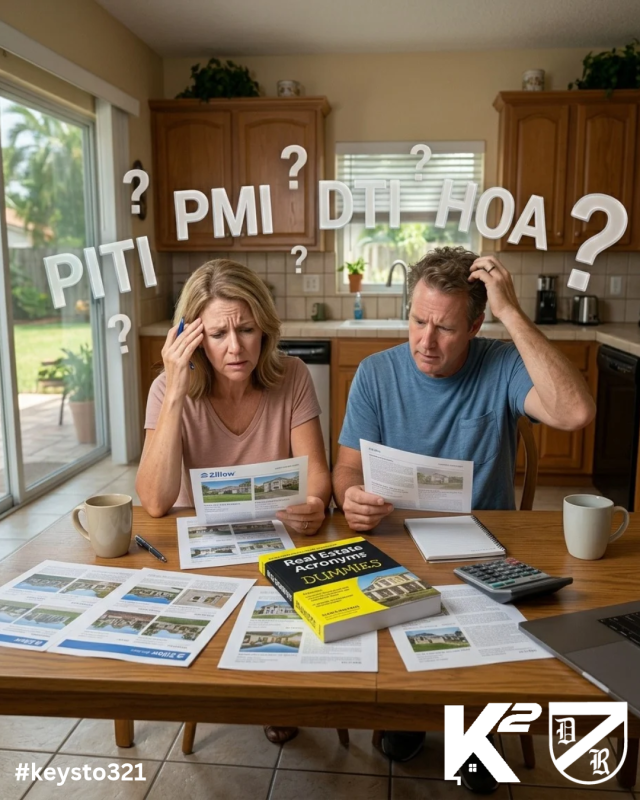
PITI vs. PMI: Buying a Home Shouldn’t Require an Acronym Decoder
Real estate has an acronym problem.
You start talking about buying a home, and suddenly someone is discussing your PITI, your PMI, your DTI, and your HOA.
At some point, you’re probably thinking, “I just wanted a house with a nice kitchen. When did this become a spelling test?”
Two terms people ask me about frequently are PITI and PMI. They sound similar, and both come up when discussing mortgage payments. But they mean different things.
Let’s translate.
What Is PITI?
PITI stands for Principal, Interest, Taxes, and Insurance. These are four basic components used to describe a monthly housing payment:
-
Principal: The money that pays down your loan balance.
-
Interest: What the lender charges you to borrow the money.
-
Taxes: Your property taxes.
-
Insurance: Your homeowners insurance.
If you have an escrow account, your lender generally collects money toward property taxes and insurance with your mortgage payment and pays those bills when they come due. Without escrow, you pay those bills separately—but they still belong in your housing budget.
That’s why a principal-and-interest payment alone doesn’t tell you everything you need to know about affordability.
What Is PMI?
PMI stands for Private Mortgage Insurance. It is commonly required on a conventional mortgage when your down payment is less than 20%.
Here’s the detail that catches people off guard: you typically pay for PMI, but it protects the lender if you stop making your mortgage payments.
It does not insure your house or your belongings. That’s a different job from homeowners insurance.
PMI is often paid monthly as part of your mortgage payment, although upfront and combination payment options also exist.
How Do PITI and PMI Fit Together?
PITI describes a group of housing expenses. PMI is a specific insurance charge that may apply to your loan.
For a clear comparison, ask your lender to show principal, interest, property taxes, homeowners insurance, and any mortgage insurance as separate line items. Some payment summaries group insurance costs together, so always confirm what the quoted total includes.
Here’s an illustration only—not a current rate quote or an estimate for a particular home:
| Monthly expense | Example amount |
|---|---|
| Principal and interest | $2,000 |
| Property taxes | $350 |
| Homeowners insurance | $250 |
| Subtotal before PMI | $2,600 |
| Monthly PMI, if applicable | $125 |
| Total including PMI | $2,725 |
Those extra letters can make a real difference in your monthly budget.
Does PMI Last Forever?
For many conventional mortgages, borrower-paid PMI can eventually be removed.
You can generally request cancellation when your principal balance reaches 80% of the home’s original value, subject to payment history and other requirements. Automatic termination generally occurs when the balance is scheduled to reach 78%, provided you’re current on payments.
The details matter, so ask your mortgage servicer what applies to your loan. Reaching a certain amount of equity does not mean every type of mortgage insurance automatically disappears.
And because apparently we needed another acronym: FHA loans have their own mortgage insurance, commonly called MIP, with different rules.
Ask for the Whole Monthly Number
When you’re buying a home on Florida’s Space Coast, the useful question is:
“What will my total monthly housing expense be, and what does that number include?”
Ask about property taxes, homeowners insurance, any mortgage insurance, association dues, and any separate flood insurance costs. Leave room for utilities, maintenance, and repairs, too.
A home’s price is only one part of deciding whether it fits your life.
You Don’t Need to Speak Fluent Mortgage
Nobody should feel embarrassed asking what an acronym means. Buying a home is a major decision, and you deserve explanations you can actually use.
My job is to help you understand the process and work with your lender to get clear answers—not leave you nodding along through alphabet soup.
Thinking about buying on the Space Coast? Let’s talk through your questions, translate the jargon, and help you move forward with confidence.
Kemper Kefauver | Keys to 321 | Daignault Realty